
Rugby
Modern precision and timeless charm reshape a classic Charlottesville four-over-four.








Rugby
Renovation
Classic Charlottesville Home Renovation With Spatial Clarity
Set on a spacious lot in one of Charlottesville’s most wooded and walkable neighborhoods, Rugby began as a timeless brick four-over-four with a quiet, steady presence. Over time, a series of disjointed additions compromised both its function and form, leaving the house fragmented and difficult to navigate. For a family of four who value both daily time together and hosting friends and extended family, the project focused on bringing the interior into alignment with the life already happening around it. The renovation restores clarity to the home’s organization while introducing a more refined and cohesive architectural language.
A Kitchen That Reclaims the Center of the Home
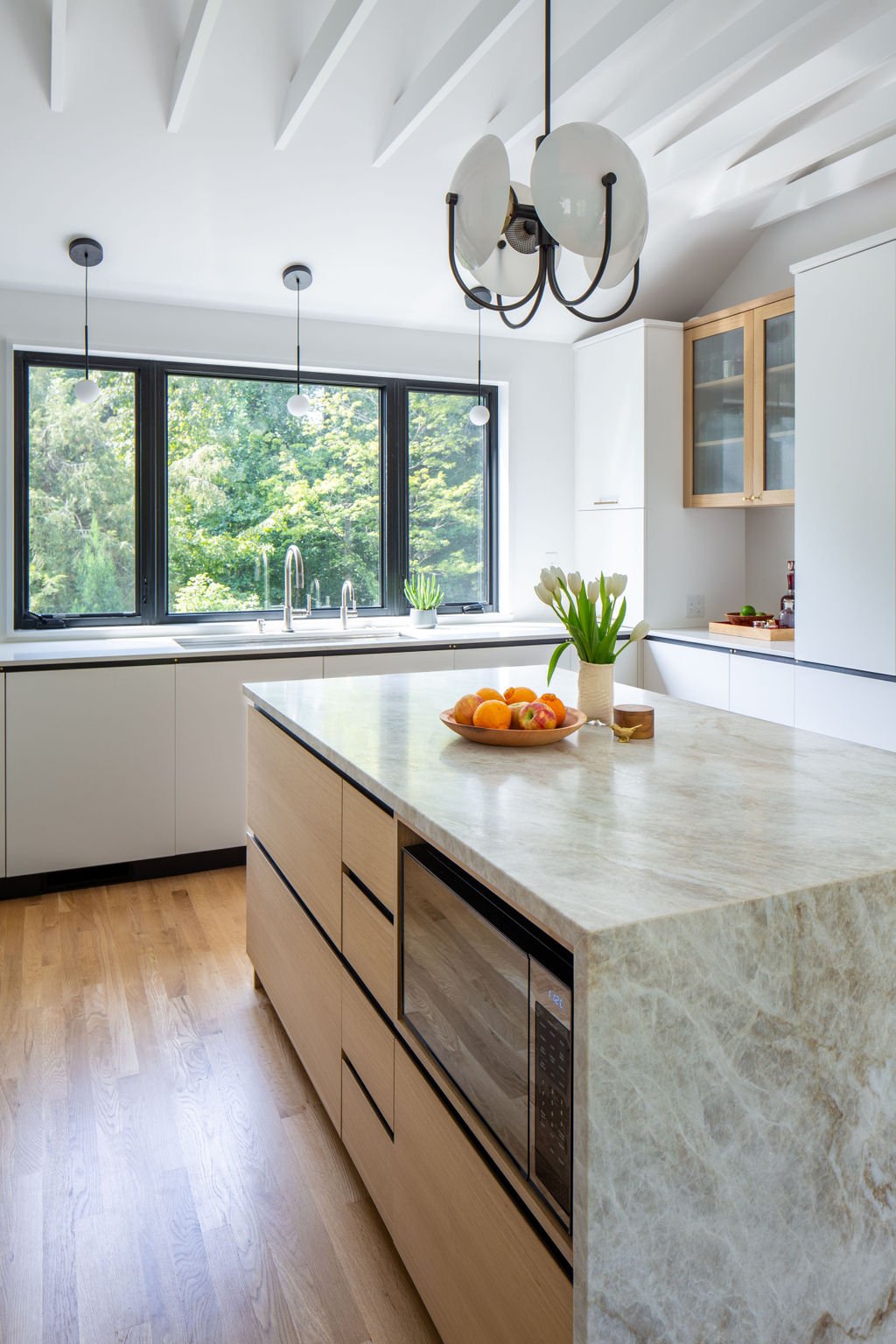
The kitchen serves as both the informal heart of the home and the primary point of entry. This dual role demanded a space that could handle daily arrival, cooking, and gathering without conflict. The existing kitchen was constrained by low ceilings, limited natural light, and a layout that worked against both use and movement. The intervention focused on vertical expansion rather than footprint. The ceiling was vaulted and structural elements exposed to create volume and legibility within the same footprint. Along the rear wall, eight feet of countertop-to-ceiling casement windows bring in consistent daylight and frame the backyard, reconnecting the kitchen to the landscape. In daily use, the space shifts easily between functions. It supports focused cooking, informal meals, and the constant movement of family life without feeling compressed or overextended.
An Island That Anchors Work and Gathering
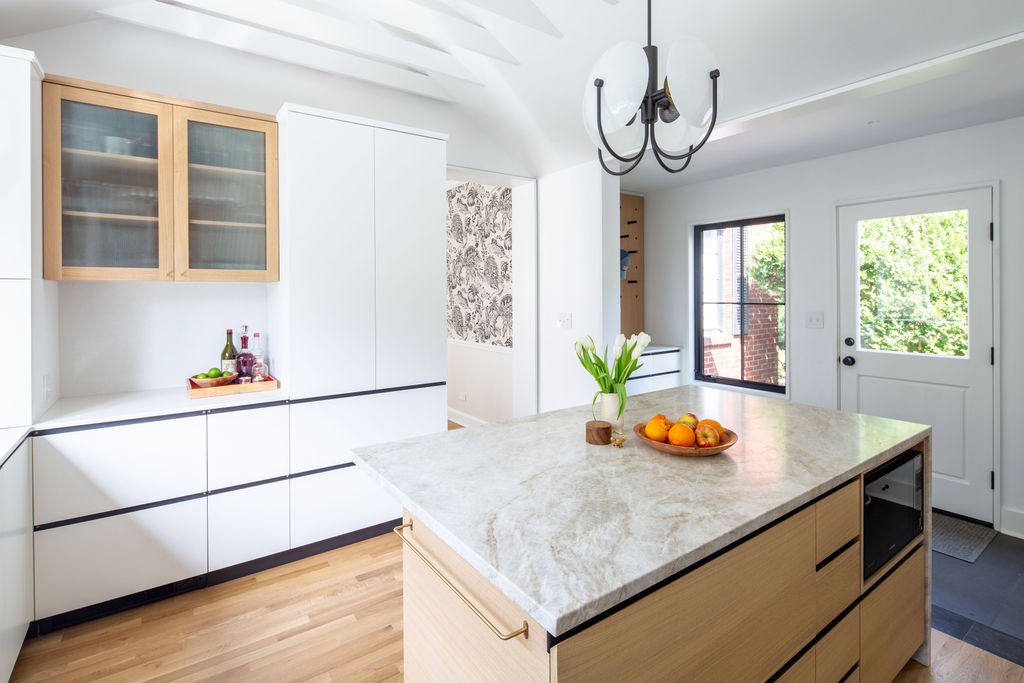
At the center of the kitchen, a white oak island establishes a clear working and social anchor. This element exists to consolidate activity into a single, legible surface rather than dispersing it across the room. It supports meal preparation, casual seating, and everyday routines such as homework, allowing multiple uses to happen simultaneously without conflict. Its material expression allows it to read more like a furniture piece than fixed cabinetry, reinforcing the kitchen’s role as a gathering space.
A Hardware-Less System That Simplifies Use
Given the compact footprint, cabinetry was designed with an integral pull system in blackened brass. This detail exists to eliminate protruding hardware, reducing visual noise and improving circulation within tight clearances. In use, this allows movement through the kitchen to remain unobstructed while maintaining a consistent tactile experience across all cabinet fronts. The palette of white oak and painted white cabinetry further separates working surfaces from storage, giving the room a clear visual hierarchy.
Precision as a Spatial Strategy
Because the kitchen operates within a limited footprint, alignment and detailing are treated as primary design tools. Millwork reveals, cabinet rhythms, and window placements are carefully coordinated so the space reads as calm and ordered. This level of precision is not aesthetic alone. It allows the kitchen to feel larger and more usable than its dimensions suggest, reducing friction in daily movement and reinforcing a sense of clarity.
A Primary Suite Defined by Light and Material Continuity
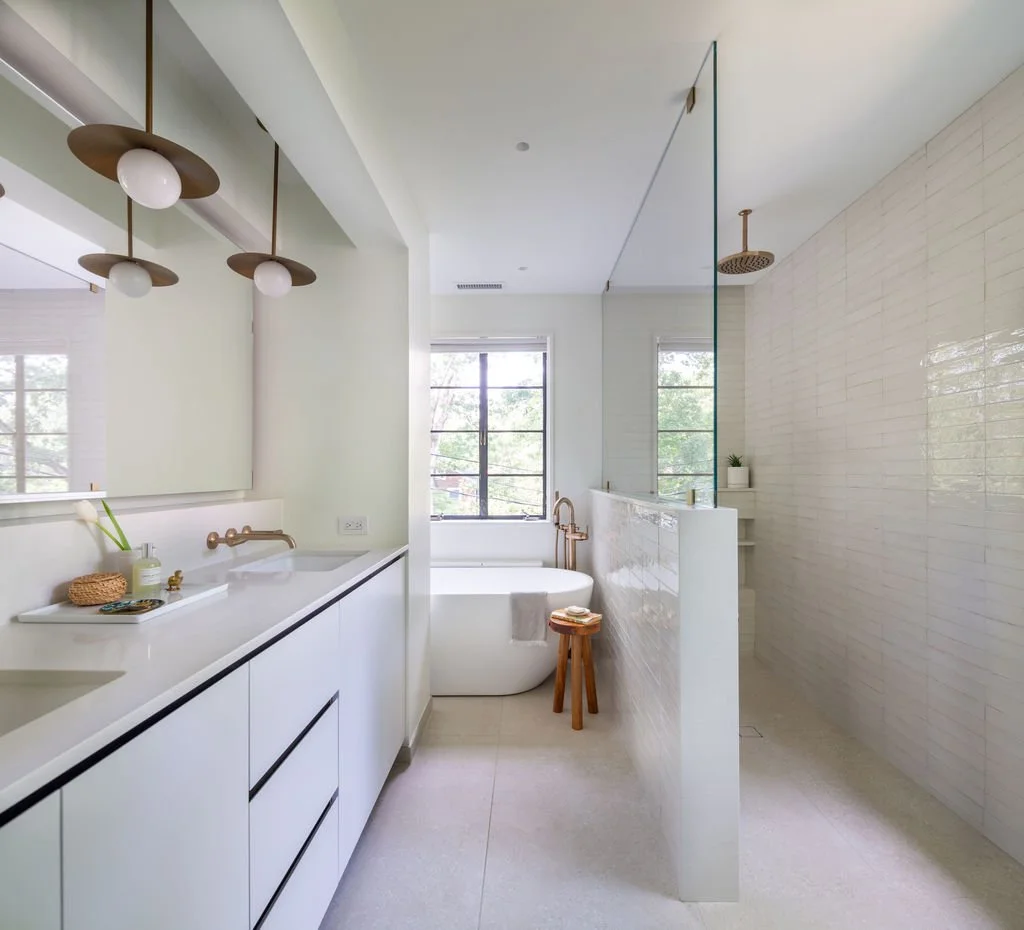
Upstairs, the primary bathroom extends the material language of the kitchen into a quieter, more private space. Handmade white mosaic tile wraps the room, reflecting natural light and softening the enclosure. A white stone vanity top and painted cabinetry maintain continuity, while the same blackened brass pull system reinforces consistency across the home. Warm brass fixtures introduce contrast and depth, creating a space that feels calm and personal rather than overly minimal. In daily use, the bathroom becomes a place of retreat that still feels connected to the larger design language of the house.
A Lower Level That Expands Daily Use
The basement was fully reworked to support the broader needs of the household. It includes a guest bedroom and bath, laundry, gym, storage, and a media room. This level exists to absorb functions that would otherwise compete for space upstairs. In use, it allows the home to flex. Guests have privacy, storage is consolidated, and the media room provides a dedicated space for evenings and gatherings without disrupting the main living areas.
A Study in Cohesion
Rugby is a study in refinement. The project does not rely on large formal gestures, but on the careful coordination of space, light, material, and detail. The result is a home that retains its architectural roots while functioning with greater clarity. Circulation is more intuitive, spaces support both daily routines and hosting, and the house feels unified rather than accumulated.