
Montrose
Small but mighty, a petite Charlottesville cottage conceals an unexpectedly spacious interior.




Montrose
Addition + Renovation
Small Charlottesville Cottage Renovation With Vertical Expansion
Tucked into Charlottesville’s Belmont neighborhood, Montrose presents as a modest home that sits comfortably within its historic streetscape. Its exterior remains quiet and familiar, but the original interior lacked the spatial capacity to support contemporary living. The project focuses on increasing usable space without altering the home’s footprint. This is achieved through a targeted restructuring of the roof, allowing volume to be captured rather than added. The result is a house that feels significantly larger than its size suggests, while maintaining its relationship to the neighborhood.
A Roof Reworked to Create a Loft
The primary move is the restructuring of the roof over the main living spaces to introduce an open loft. This element exists to add functional square footage without expanding outward, using vertical space as the primary resource. The loft is scaled for flexible use as a home office or creative workspace. In daily use, it separates focused work from the activity below while remaining visually connected to the main living area. This maintains a sense of openness while allowing distinct modes of use.
A Ladder That Reinforces Material Continuity
Access to the loft is provided by a custom steel ladder with white oak rungs. This element exists to provide efficient vertical circulation without consuming the limited floor area required by a conventional stair. The oak rungs reference the original hardwood floors, tying the new intervention back to the existing material language. In use, the ladder becomes both a functional element and a point of interaction, reinforcing the compact, intentional nature of the space.
An Exposed Flue as Spatial Anchor
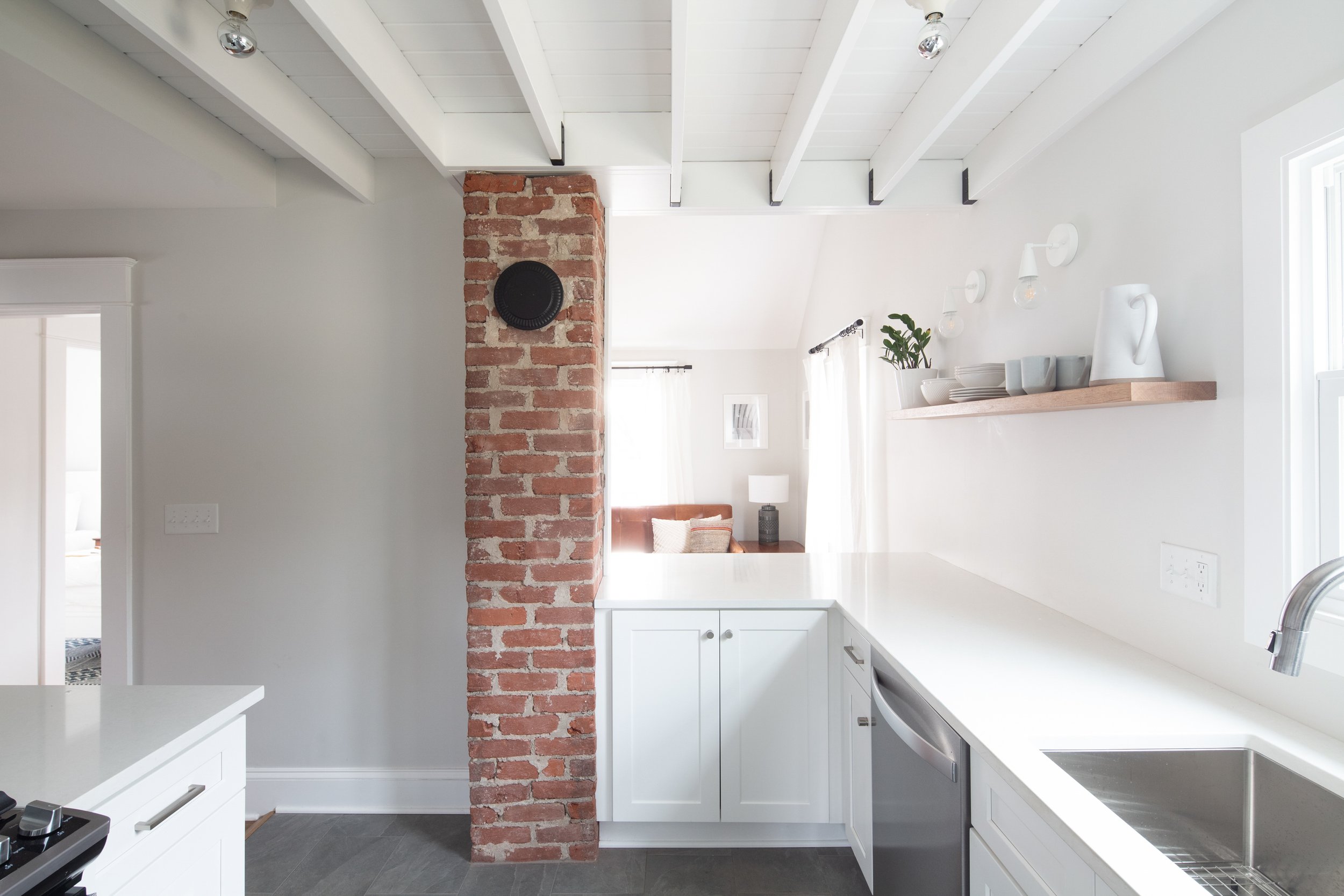
During construction, an original brick mechanical flue was uncovered and left exposed. This element exists as both a retained artifact and a new organizing feature within the plan. Rather than conceal it, the flue informs the layout of the adjacent kitchen and living space. In daily use, it provides a fixed point within the interior, helping to anchor movement and give the small footprint a sense of structure and identity.
A Kitchen Shaped by Structure and Constraint
The kitchen is organized in response to the exposed flue and the loft structure above. This approach exists to integrate new work with existing conditions rather than override them. Exposed framing at the loft edge reinforces a more direct, material expression, while the kitchen layout maximizes efficiency within tight dimensions. In use, the space supports cooking and gathering without excess, relying on precision rather than size.
A Balance of Industrial and Natural Materials
The material palette combines retained brick, exposed structure, steel, and wood. This balance exists to connect the home’s original character with its updated use. The contrast between industrial elements and warmer wood surfaces creates a layered environment that feels both grounded and current. In daily use, the materials register touch, wear, and light, giving the compact interior depth.
A Compact House With Expanded Capacity
Montrose is defined by efficiency. The project uses a single strategic move, restructuring the roof, to unlock additional space while preserving the home’s footprint and exterior presence. The result is a small house that operates with greater flexibility and clarity. Living, working, and gathering are supported within a compact envelope, with each element carefully positioned to maximize both space and use.